Glass or plastic? It is one of the first decisions parents make when buying a feeding bottle. Both can be completely safe for your baby, but they suit different families and situations. Here is an honest comparison to help you choose.
Quick comparison
| Glass bottle | Plastic (BPA-free PP) bottle | |
|---|---|---|
| Safety of material | Inert, no chemicals to leach | Safe if BPA-free and used correctly |
| Weight | Heavier | Light, easy for baby to hold |
| Breakage | Can break if dropped | Does not break |
| Scratches and smells | Does not scratch, stays clear, holds no smell | Can scratch and get cloudy over time |
| Boiling and sterilising | Handles heat very well | Fine, but heat ages it faster |
| Lifespan | Very long if not broken | Replace when scratched or cloudy |
| Price | Higher | Lower |
| Best for | Home feeding, parents who sterilise often | Travel, daycare, older babies who hold the bottle |
Glass feeding bottles: pros and cons
Pros:
- Glass does not react with milk, even when it is hot.
- Easy to see if it is clean. No scratches for milk residue to hide in.
- Does not absorb smells or stains, and can be boiled again and again.
- Lasts a long time, so you can use it for more than one baby.
Cons:
- Heavier, which is hard for a baby to hold alone.
- Can break if dropped, so it is less suitable for travel or for older babies who throw things.
- Costs more.
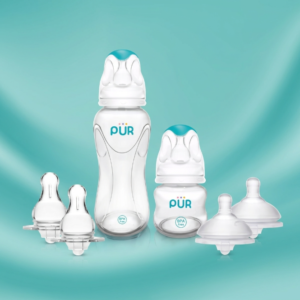
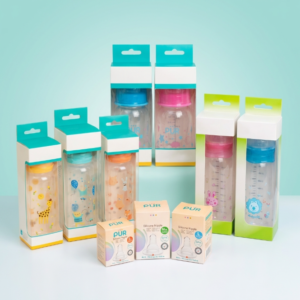
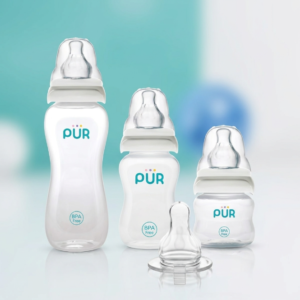
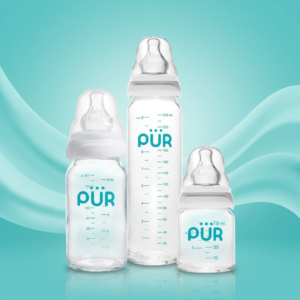
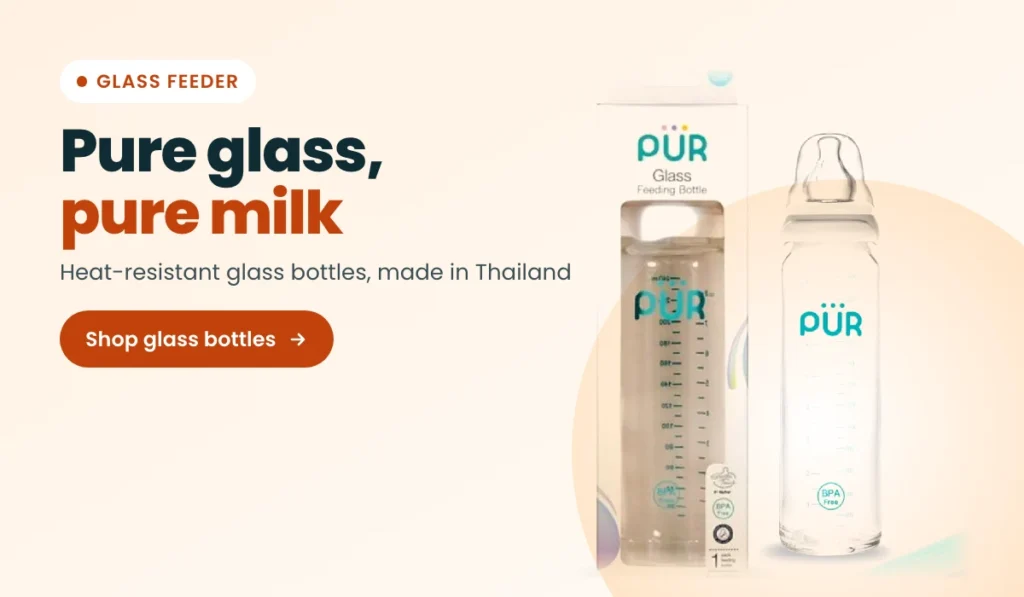
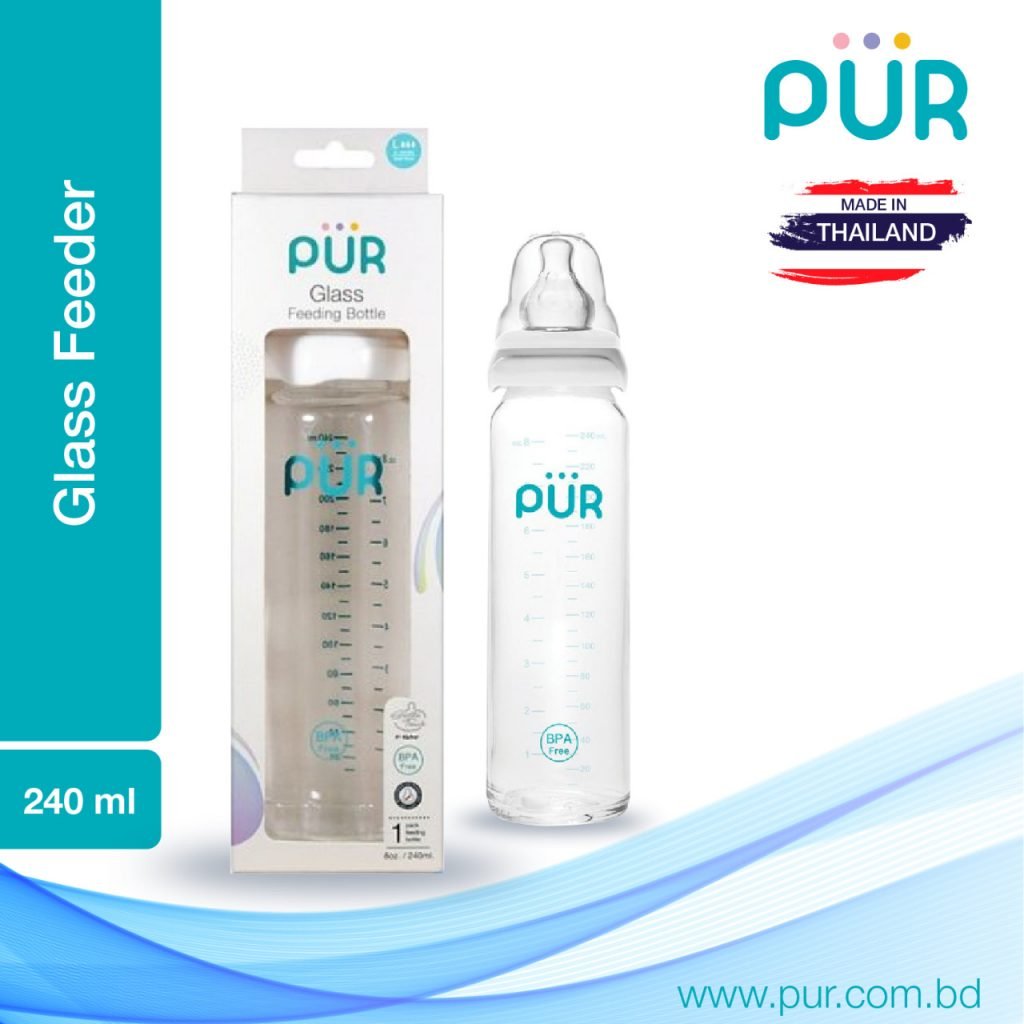
The PUR glass feeding bottles come in 60ml, 130ml and 240ml sizes, with a Pro-flo anti-colic silicone nipple.
Plastic feeding bottles: pros and cons
Pros:
- Light and unbreakable. Easy for parents to carry and for babies to hold.
- Many shapes, including easy-grip, anti-colic and wide neck designs.
- More affordable, so it is easy to have several bottles ready.
Cons:
- Can get scratched and cloudy with time and needs replacing more often.
- Cheap, unbranded plastic may not be BPA-free. Always buy from a trusted brand.
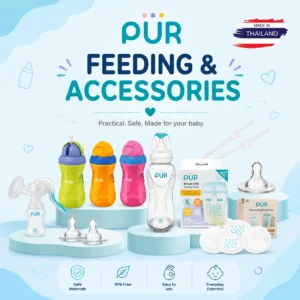
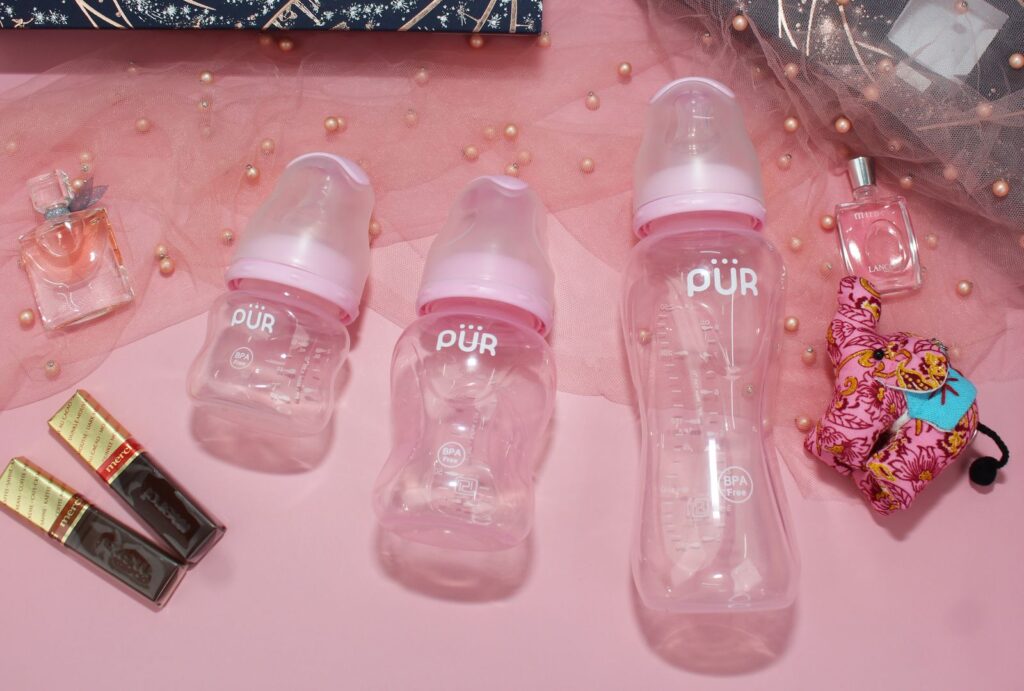
Popular PUR plastic bottles include the Advanced Slim Neck range, the Straight Anti-Colic Feeder and the Comfort Feeder range. All are BPA-free.
How to use plastic bottles safely
- Choose bottles clearly marked BPA-free from a known brand.
- Don’t put plastic bottles in the microwave to warm milk. Warm the milk in a bowl of warm water instead.
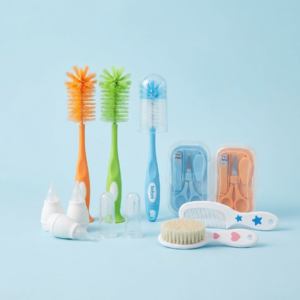
- Wash with a soft bottle brush, not abrasive scrubbers, to avoid scratches.
- Replace bottles that are scratched, cracked, cloudy or have a smell that won’t wash out.
How to use glass bottles safely
- Check for chips or cracks before every feed.
- Avoid sudden temperature changes, such as pouring boiling water into a cold bottle.
- Feed with the bottle in your hand rather than letting your baby hold it alone.
Which should you choose?
- Choose glass if you mostly feed at home, sterilise by boiling often, and want a bottle that lasts.
- Choose plastic if you travel, use daycare or a helper, or your baby has started to hold the bottle alone.
- Many families use both: glass at home and plastic for going out.
Frequently asked questions
Are glass feeding bottles safer than plastic?
Glass is chemically inert, but BPA-free plastic bottles from a trusted brand are also safe when used correctly. The bigger safety factors are cleaning properly and replacing worn nipples and bottles.
From what age can a baby use a glass bottle?
Glass bottles can be used from birth with a slow-flow nipple, and an adult should hold the bottle. Check the age label on the nipple that comes with each bottle, and change to a slow-flow (S) nipple for a newborn if needed.
Can I boil a plastic feeding bottle?
Yes. PUR plastic bottles can be sterilised by boiling. Frequent boiling makes plastic age faster, so replace it when it looks worn.
Do PUR glass and plastic bottles use the same nipples?
It depends on the neck width. Check whether your bottle is slim (standard) neck or wide neck, and buy the matching nipple. See our nipple size guide.